

By: Spencer Neff
May 27, 2023
Since the inaugural running in 1911, the Indianapolis 500 has become a race of traditions. One of the most storied traditions in what will soon. be the 105 runnings of the race is the storied “Field of 33” or “11 rows of 3” as those who love this race may refer to it.
Like many of the race’s storied traditions, this has not been a static part of its history. In 1911, 40 cars took the start. Prior to World War I forcing the cancelation of the 1917 and 1918 races, that number dipped as low as 21. In 1919, 33 cars started the race, as would be the case again 1927, 1929 and 1934. In between, more cars were entered, including a record 42 in 1933.
In 1979 and 1997, 35 were entered but since 30 cars were entered in 1947’s race, all other runnings of the Indianapolis 500 have featured 33 cars.
Making the race can often be the culmination of a career’s worth of hard work for both driver and crew, regardless of qualifying position.
Today, we’ll look back at some of the historic final rows in “500” history.
“Bumped”: 1980-Tom Bigelow (31st to eighth), Gary Bettenhausen (32nd to third) and Tom Sneva (33rd to second) become the first trio of last-row starters to finish in the Top 10. Sneva qualified 14th but would start 33rd after crashing his primary car.
1952: Former winner Parsons is joined by Mcdowell, future winner Sweikert
The last row of the Indianapolis 500 has never featured multiple winners on the last row for its race day starting lineup (Tom Sneva qualified alongside Gordon Johncock in 1992 but Scott Goodyear replaced Mike Groff, moving Sneva to Row 10).
Forty years earlier, one former winner was joined by a future winner on the last row of three.

In 1950, Johnnie Parsons won a race that was shortened due to rain after 138 of 200 laps. Two years later, he would start the race in 31st. Starting next to Parsons on the 11th row would be Delavan, Illinois native Johnny McDowell, an accomplished Sprint Car driver in his fourth race.
McDowell had won the 1948 title at Soldier Field (home of the NFL’s Chicago Bears often used as a race track).
Starting 33rd was Rookie Bob Sweikert, making his debut in the race after failing to qualify the previous two years. Three years later, Sweikert would go on to win not only the “500” but the AAA National Chamionship and Midwest Sprint Car title as well, the only driver to do so.
It would be 58 years before two future winners shared the last low, when Tony Kanaan and Takuma Sato would occupy the 11th row
1967: Miller lines up with Formula 1 stars Rindt and Hill
The 1960s were a decade of innovation and star power, with the “rear-engine revolution” and the “British Invasion” taking center-stage. 1967 would include one of the most decorated starting fields in history.
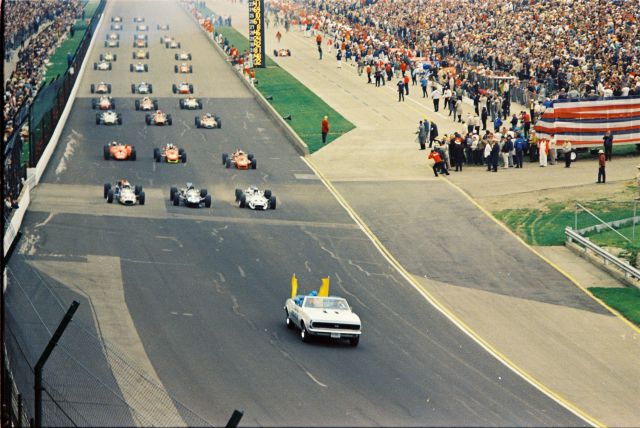
Even the list of those not making the field includes names like Peter Revson, Pedro Rodriguez and Jim Hurtubise. On the 11th row for the “500” included F1 legend and defending “500” winner Graham Hill, 1966 24 Hours of LeMans co-winner Jochen Rindt and Al Miller, who earned a best finish of fourth two years earlier.
Hill and Miller would fall out of the race before halfway due to mechanical issues. Rindt would finish 24th after completing 108 laps. It would be the final appearance in the “500” for Miller, while Rindt and Hill would compete in their last a year later. In 1970, Rindt was fatally injured in a crash during the Italian Grand Prix in Monza in 1970. He would become the only posthumous champion.
2015: Davison, Vautier and Briscoe comprise “substitute” last row
A week prior to the 99th Indianapolis 500, the first “Last Row Shootout” had been completed as Jack Hawksworth,Stefano Coletti and Bryan Clauson made it in to the race with 1996 winner Buddy Lazier failing to qualify.
Within five days, all three were moved to the 10th row. In Monday practice, Schmidt Peterson Motorsports’ James Hinchcliffe suffered a near-fatal crash in Turn 3. Fortunately, he recovered and even won pole in 2016. However, SPM would call on 2012 pole winner Ryan Briscoe to fill the No. 5.
After qualifying James Davison’s car, 2013 INDYCAR Rookie of the Year Tristan Vautier was scheduled to compete overseas in sports cars.
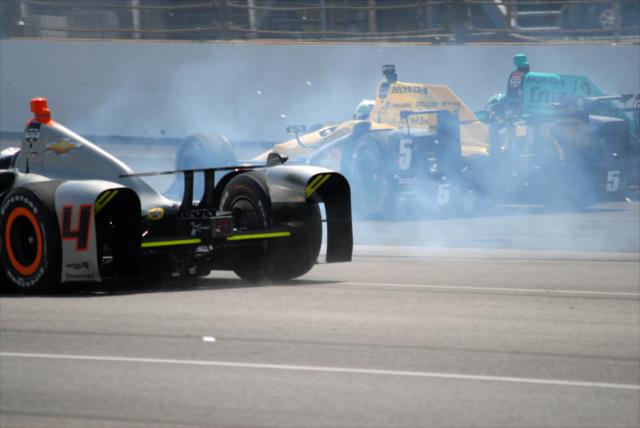
On Carb Day, Dale Coyne Racing’s Carlos Huertas was ruled out by an inner ear infection, prompting Vautier to fill in for a second straight weekend. After having Vautier qualify the car due to his own prior commitments, James Davison was moved from 33rd to 31st as a result of the additional driver changes.
Briscoe finished 12th, while Vautier and Davison collided with DCR teammate Pippa Mann on pit road
This weekend has a similar circumstance. Following Stefan Wilson’s crash and fractured 12th thoracic vertebrae, Graham Rahal will occupy the spot. It is the first time since 2015 a driver who qualified for the race will not start.
Header Image By Joe Skibinski/INDYCAR
 IndyCar1909.com