

By: Spencer Neff
September 28, 2023
Although the Auto Club Speedway (originally California Speedway) has been off the INDYCAR Schedule since 2015, the 2-mile oval holds a special place in the sport’s history.
In the first off-season edition of Rewind, we’ll look at the first open-wheel race held at the Fontana, California facility: the 1997 Marlboro 500, held 26 years ago on this day.
Mark Blundell completes breakout season with victory in Fontana’s debut
After finishing third and fifth at Laguna Seca respectively, Chip Ganassi Racing’s Alex Zanardi and Walker Racing’s Gil de Ferran secured the top two spots for the PPG CART World Series in 1997.
Despite first and second in the championship already clinched, the 1997 season finale would be met with no shortage of its own headlines.
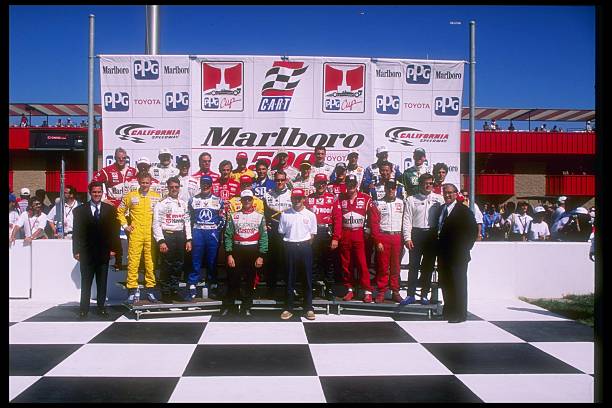
The newly built California Speedway, a 2-mile oval, would host its first INDYCAR race. Owned and operated by Team Owner Roger Penske, the immaculate facility was billed as a sister track to the Penske-Owned Michigan International Speedway. California did however, feature slightly flatter corners (14 degrees of banking compared to 18 degrees at MIS).
In contrast to his winning effort at Michigan in July, Zanardi would not match that success at California. After crashing twice on Friday, the five-time winner in 1997 was ruled out for the weekend due to a concussion.
Taking his place would be Arie Luyendyk, who won his second Indianapolis 500 four months earlier. He would return to CART for the first time since the 1996 CART/IRL Split. Luyendyk had driven for CGR in 1992-1993, winning his first of three pole for the Indianapolis 500 in 1993.
Also missing from the grid would be Rookie of the Year winner Patrick Carpentier, who also crashed during the weekend, forcing him out of the race.
Another familiar name would make his return to the series, as Robby Gordon would pilot the No. 9 for Hogan Racing in the wake of Dario Franchitti’s departure.
On track, speed was the big headline leading into the race. PacWest Racing’s Mauricio Gugelmin earned his third pole of the season with a 240.942 mile per hour lap. The Brazilian set a world closed circuit speed record and was the only driver of the 27-car field to eclipse the 240 mph barrier.

Prior to the start, a major fire broke out in Juan Manuel Fangio II’s Reynard-Toyota, ending his day before it began. The All-American Racers’ driver would not complete a lap in his final series appearance.
Following a caution to clean up the debris, the green flag would be displayed for a Lap 12 restart. A lap later, Paul Tracy crashed in Turn 4, ending a season that saw him win three consecutive races and lead the points early in the season. He would move from Penske to Team Green for 1998.
After the Lap 23 restart, Gugelmin held a steady lead over 1996 Series Champion Jimmy Vasser of Chip Ganassi Racing. Vasser’s Fontana teammate for the race would suffer an unfortunate end to his return after Arnd Meier spun in Turn 4, colliding with Luyendyk. Hiro Matsushita would be forced out of the race after hitting debris from the crash.
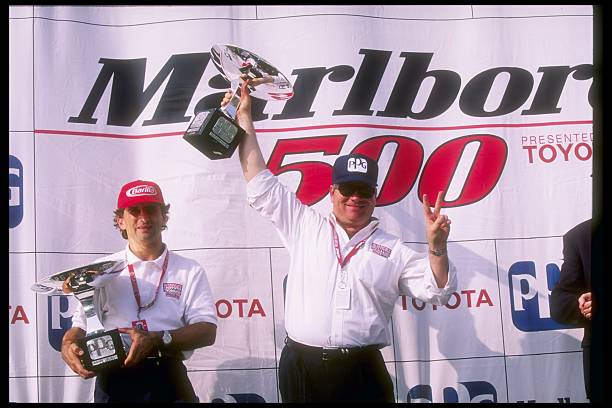
Gugelmin would control the lead of the race until his Lap 43 pit stop under caution when Michael Andretti was first off pit lane. Following the caution, the Homestead would lead until Lap 83, looking to bookend his season with another oval victory.
Following three cautions within the first 51 laps (first 12 laps run under caution), the next 67 laps would be run under green prior to a debris caution. Attrition did play a factor as was the case in many 500-mile races, eliminating Bryan Herta and Michael Andretti due to electrical and overheating issues respectively.
Tasman Motorsports’ Andre Ribeiro, who extended his streak to five consecutive 500-mile races led, saw his chances at victory evaporate during the waning laps.
On Lap 204, he ran out of fuel, coasting to his pit stall. Four laps after the stop, the No. 31 drifted into the outside retaining wall, then spun and crashed in Turn 2, ending his day after leading a race-high 114 of 250 laps. For 1998, Ribeiro moved on to Penske in what became his final season in the series.
Gugelmin would usurp the lead from de Ferran going into Turn 1 on the Lap 216 restart.
At Lap 232, Forsythe Racing’s Greg Moore rocketed past for the lead as the PacWest driver made an unscheduled pit stop. Like many of his competitors running Firestone tires, he fell victim to a blistering set.
Gugelmin fell short of the $115,000 Marlboro Bonus for winning from the pole.
Moore, who earned his first victories at Milwaukee and Belle Isle in June of 1997, would see his day end with less than 11 laps to go as his Mercedes-Benz engine gave out. In the midst of the issue, Gugelmin’s teammate Mark Blundell swept past Vasser, who had slowed in anticipation of a caution.
Vasser would close the gap but it was Blundell taking his third victory of 1997 and first on an oval to go with road (Portland) and street (Toronto) course wins. Vasser finished .847 of a second back, lamenting the lack of caution for Moore’s engine issues.

Tasman Motorsports completed the podium with Adrian Fernandez in third, delivering the Lola chassis’ best finish of 1997.
After scoring his first and only victory at Vancouver four weeks earlier, Gugelmin would finish the race in fourth and secure the same position in the final standings behind Zanardi, de Ferran and Vasser.
Analysis
While Zanardi and CGR would celebrate their championship with Reynard winning the manufacturer’s title, Blundell’s victory helped give Mercedes Benz the Engine Championship, their first open-wheel crown since 1955 (Formula 1).
PacWest did not return to victory lane until 2001 with rookie Scott Dixon at Nazareth, who had replaced a departing Blundell to begin 2001. Following that season, Gugelmin would step away from racing and PacWest shut its doors four races into the 2002 season.
In 2000, Gugelmin’s pole speed was topped at Fontana by de Ferran’s Reynard-Honda as the Penske driver clocked a lap at 241.428 mph. They are the only drivers to exceed 240 mph in an offical IndyCar lap.
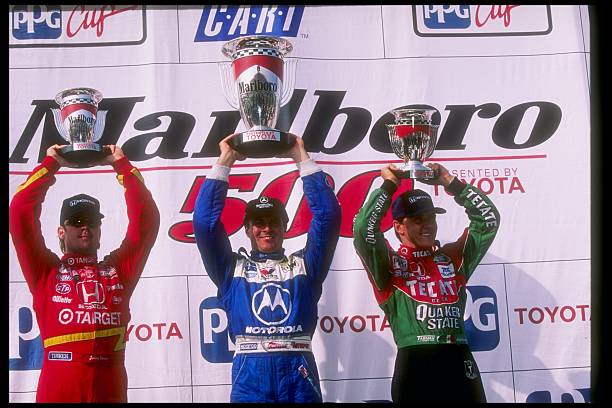
The podium for the inaugural race would be occupied by the first three winners at California Speedway. Vasser and Fernandez won in 1998 and 1999 (Patrick Racing with Fernandez) respectively, with the former also winning in 2002 with Team Rahal.
California Speedway’s inaugural race featured 13 lead changes among seven drivers, compared with 13 among nine drivers in the U.S. 500 at Michigan in July.
In the years following, super speedway racing in CART (Championship Auto Racing Teams) would change dramatically. At Michigan and Fontana, a new wing (Hanford Device) would be introduced, creating a boom in lead changes for both 500-mile events.
CART raced nine times with the Hanford Device from 1998-2002 and seven of those races featured 40 or more lead changes, highlighted by 73 in a 2001 Fontana race shortened by 30 laps to 220.
The last IndyCar race at the Auto Club Speedway in 2015 featured a record-breaking 80 lead changes and was won by Graham Rahal. In 2020, the venue announced plans for a reconfiguration to a half-mile short track. While those plans have not come fruition at this time, it is unlikely the oval will return to the IndyCar Schedule.
Header Image By History in IndyCar/X (Twitter)
 IndyCar1909.com